The short answer
Building your own software makes your plant responsible for its security. Customers will ask for a SOC 2 Type II report, which means a yearly audit by a licensed CPA firm. You also need independent penetration testing at least once a year and after major changes, plus engineers to patch what the testers find. Most manufacturers are better off buying from a vendor that already does this.
When a manufacturer builds its own software, it also takes on a security program: an annual audit, independent attack testing and constant patching. In a build vs buy software decision, that program is the cost most plants leave out. Here is what each piece involves, and why most plants should not take it on.
Why are manufacturers a ransomware target?
Attackers go after manufacturers because every hour of downtime costs money, and that pressure makes a plant more likely to pay. In July 2026, Coca-Cola disclosed a ransomware attack that suspended production at its Fairlife U.S. facilities. Jaguar Land Rover's 2025 attack reportedly cost £1.9 billion and disrupted more than 5,000 companies in its supply chain.
What does a SOC 2 Type II audit require?
SOC 2 Type II is an independent audit that proves your security controls worked over months, not just on paper. A licensed CPA firm runs it and tests each control against evidence. It is not a certificate you can buy.
- Framework: The AICPA's Trust Services Criteria. Every audit covers security. You add availability, confidentiality, processing integrity and privacy as your scope requires.
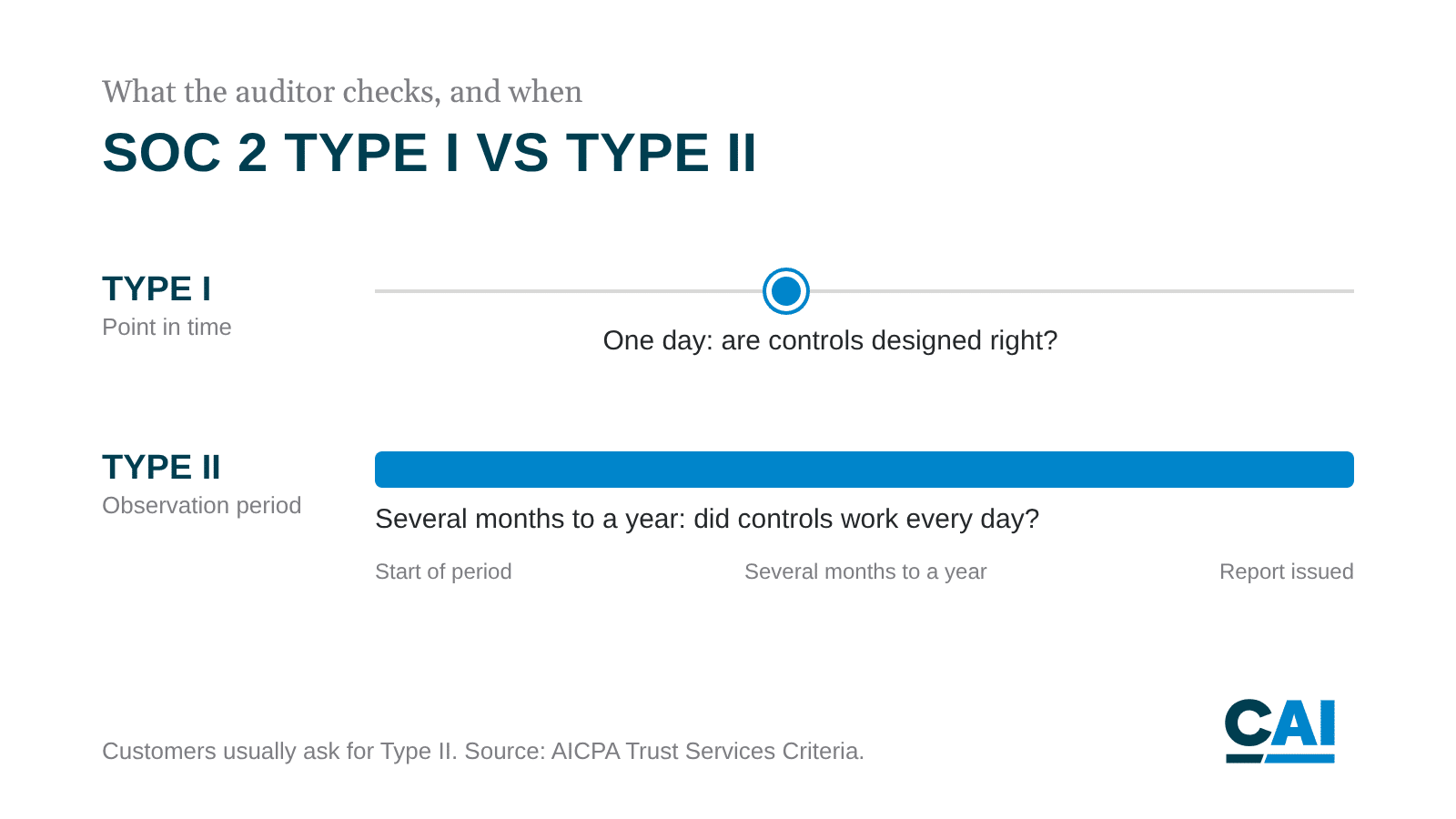
- Type I vs Type II: Type I checks that controls are designed correctly on a single day. Type II checks that they worked across an observation period, typically several months to a year. Customers ask for Type II.
- Evidence: The auditor samples proof for every control. A written policy isn't enough. You have to show your team followed it.
- Every year: The audit repeats annually, and any lapse shows up in the report.
What the auditor tests
- Access management: who can reach which systems, least privilege, multi-factor authentication and regular access reviews.
- Encryption of data in transit and at rest.
- Change management: code review, approvals and controlled deployment, so nobody ships unreviewed changes to production.
- Monitoring and logging, with alerts that someone acts on.
- Vulnerability management: finding and patching weaknesses within set timeframes.
- Incident response: a documented plan your team has rehearsed.
- Risk, vendor and HR controls: risk assessments, vetting of third-party vendors, background checks, security training and offboarding.
That last group is often the surprise for plant teams. Even an internal app built by two engineers needs vendor reviews for the cloud services it runs on. And when one of those engineers leaves, you need documented proof that their access was removed.
What is penetration testing, and how is it different from a vulnerability scan?
A penetration test is an authorized attack on your own systems. Independent security specialists try to break in the way a real criminal would. The test answers one question: if someone really tried, how far could they get?
A pen test is not a vulnerability scan. A scanner runs automatically and lists known weaknesses. Pen testers chain weaknesses together, exploit them and show the business impact, such as reaching customer data or moving from one system to another.
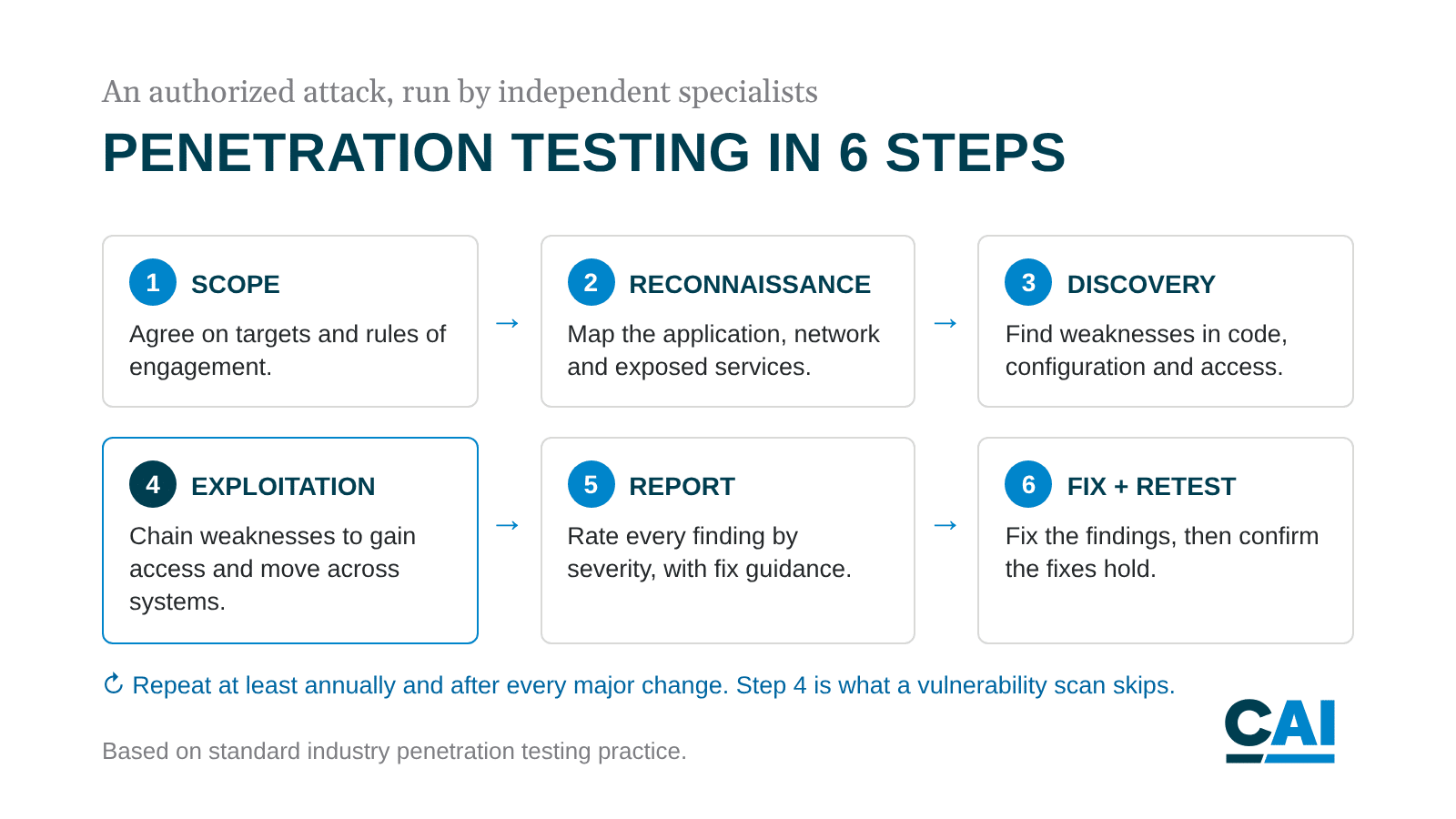
A typical test runs in six steps:
- Scope: agree on targets and rules of engagement.
- Reconnaissance: map the application, network and exposed services.
- Discovery: find weaknesses in code, configuration and access.
- Exploitation: use them to gain access, escalate privileges and move across systems.
- Report: rate every finding by severity, with fix guidance.
- Remediate and retest: fix the findings, then confirm the fixes hold.
Tests cover the external network, internal network, web application, APIs, cloud configuration and sometimes staff through social engineering. Independence matters, because the team that built a system has blind spots about it. For software that changes often, every release can reopen a gap.
How security changes the build vs buy software math
Building in-house means your plant owns the whole security program, every year: a control framework, evidence collection, an independent auditor, a pen test vendor and the engineers to fix what they find.
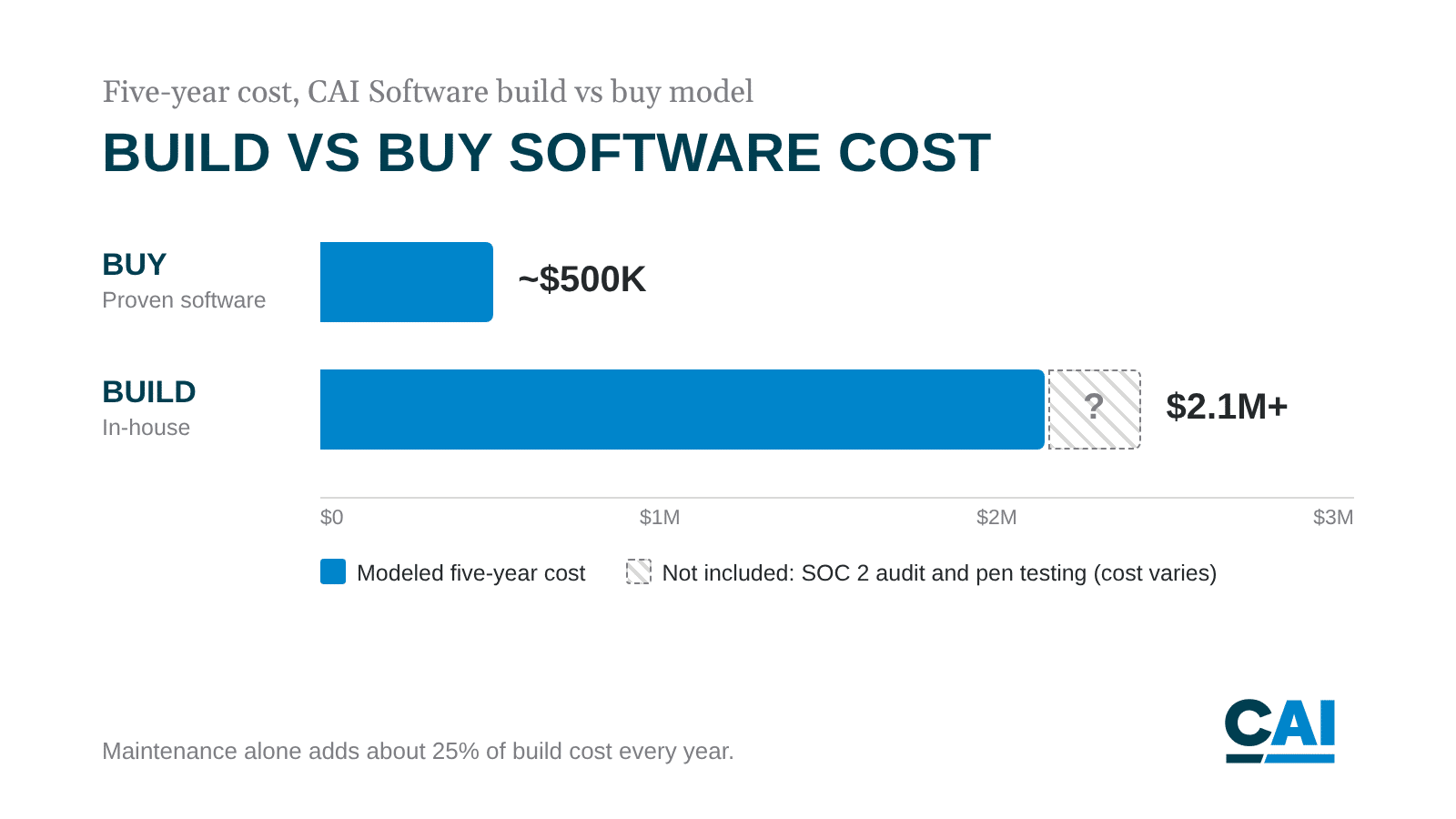
That cost sits on top of the build itself. Our build vs buy model puts five-year cost near $500K to buy proven software versus $2.1M+ to build. But that build figure doesn't include an audit or pen test program. Maintenance alone runs about 25% of build cost each year. Meanwhile, 66% of software projects fail or run into serious trouble, according to the industry research behind our model.
Should you build or buy? A three-question security check
- Can you staff the security program for the life of the software? You need an owner for SOC 2 evidence, budget for an outside auditor and pen testers, and engineers free to patch on a deadline. If not, buy.
- Will customers or your IT team ask for a SOC 2 report? If the software touches customer data, orders or quality records, expect the question. If you can't fund an annual audit, buy from a vendor that already has the report.
- Is the workflow truly unique to your plant? Build only when no product covers it and the advantage is worth owning security for years. Otherwise, buy and put your engineers on the process, not the platform.
Rule of thumb: build only if you answer yes to all three. Any no points to buying.
How CAI Software handles security
Parsable holds a SOC 2 Type II attestation and re-certifies annually. Parsable and PlanetTogether both undergo regular penetration testing. We pay specialists to attack our own software, so the gaps are found by people we hired, not by criminals. SOC 2 reports are available to customers under NDA.
Next step: request our SOC 2 report or book a build vs buy review for your plants.
Frequently asked questions
Is it safer to build or buy manufacturing software?
For most manufacturers, buying is safer. An established vendor already runs a SOC 2 Type II audit, independent penetration testing and a patching process, and spreads that cost across many customers. A plant that builds in-house has to fund and staff the same program alone, every year, for as long as the software runs.
What is the difference between SOC 2 Type I and Type II?
Type I checks that security controls are designed correctly on a single day. Type II checks that those controls actually worked across an observation period, typically several months to a year. Customers and IT teams usually ask for Type II because it proves sustained practice, not just a written plan.
How often should software be penetration tested?
Most companies run a penetration test at least once a year and again after major changes, such as a new integration or a cloud migration. Software that changes often needs more frequent testing, because each release can reopen a gap. Use an independent firm, since the team that built the system has blind spots.
Is a vulnerability scan the same as a penetration test?
No. A vulnerability scan is automated and lists known weaknesses. A penetration test uses human specialists who chain weaknesses together, exploit them and show the real business impact, such as reaching customer data or moving between systems. Scans are useful between tests, but they don't replace one.
How much does it cost to build your own software versus buy it?
CAI Software's build vs buy model puts five-year cost near $500K to buy proven software versus $2.1M or more to build. That build estimate does not include a SOC 2 audit or a penetration testing program. Maintenance alone adds about 25% of the build cost every year.
Sources
- CAI Software compliance page
- Coca-Cola Fairlife ransomware attack, Supply Chain Dive
- JLR cyberattack loss, Business Today
- Cost, maintenance and failure figures come from CAI Software's build vs buy model, which cites McKinsey/Oxford, the Linux Foundation and the Standish Group CHAOS Report.
- SOC 2 and penetration testing descriptions reflect standard AICPA and industry practice.