When a customer asks "when will this be ready?", the honest answer is rarely a single date.
By Asbjørn Bjaanes, Engineering Director, Maritech
How we treat the Maritech roadmap as a series of informed bets, not promises
Our engineering lead, Asbjørn Bjaanes, explains below why we treat the Maritech roadmap as a series of informed bets that get sharper as we learn, instead of a set of promises we hope to keep. For you as a customer, it means a roadmap you can plan around, because it is honest about what we know and what we don't yet.
There is a conversation that happens in almost every product organisation at some point. A customer asks about the roadmap. A stakeholder wants to understand where things stand. And someone pulls up a list of stories, points at completion percentages, and hopes the numbers tell the story.
Guess what? They never do!
Progress visibility is not a reporting problem. It is a structural problem. And until you address the structure, no dashboard, no metric, and no velocity chart will fix it.
The Misconception That Slows Everything Down
The most common belief I encounter is this: to show accurate progress, you need maximum detail. Break everything down, estimate every story, map every dependency, and then you will finally have a true picture of where things stand.
This belief feels logical. It is also wrong.
Detail without context is noise. And detail applied too early does something far more damaging than noise. It turns a team focused on solving problems into a team focused on following instructions. The moment you fully specify work that is six months away, you have stopped building toward an outcome. You have started building toward compliance.
The team’s energy shifts. Instead of asking “what is the right thing to build?” they ask “have we ticked all the boxes?” The stories become the goal, not the solution. And when the context changes, as it always does — nobody questions the stories, because the stories were the plan.
Roadmaps Are Not Contracts. They Are Bets.
The language we use around roadmaps matters enormously. When we call something an estimate, we imply a level of precision we rarely possess. When we call it a commitment, we create a contract. And contracts shift the team’s energy from solving to complying.
The honest framing is different. A roadmap is a series of progressively refined bets. Each bet is placed with the best information available at that moment, at the right level of confidence for that stage of the work. As new information arrives, the bet is updated.
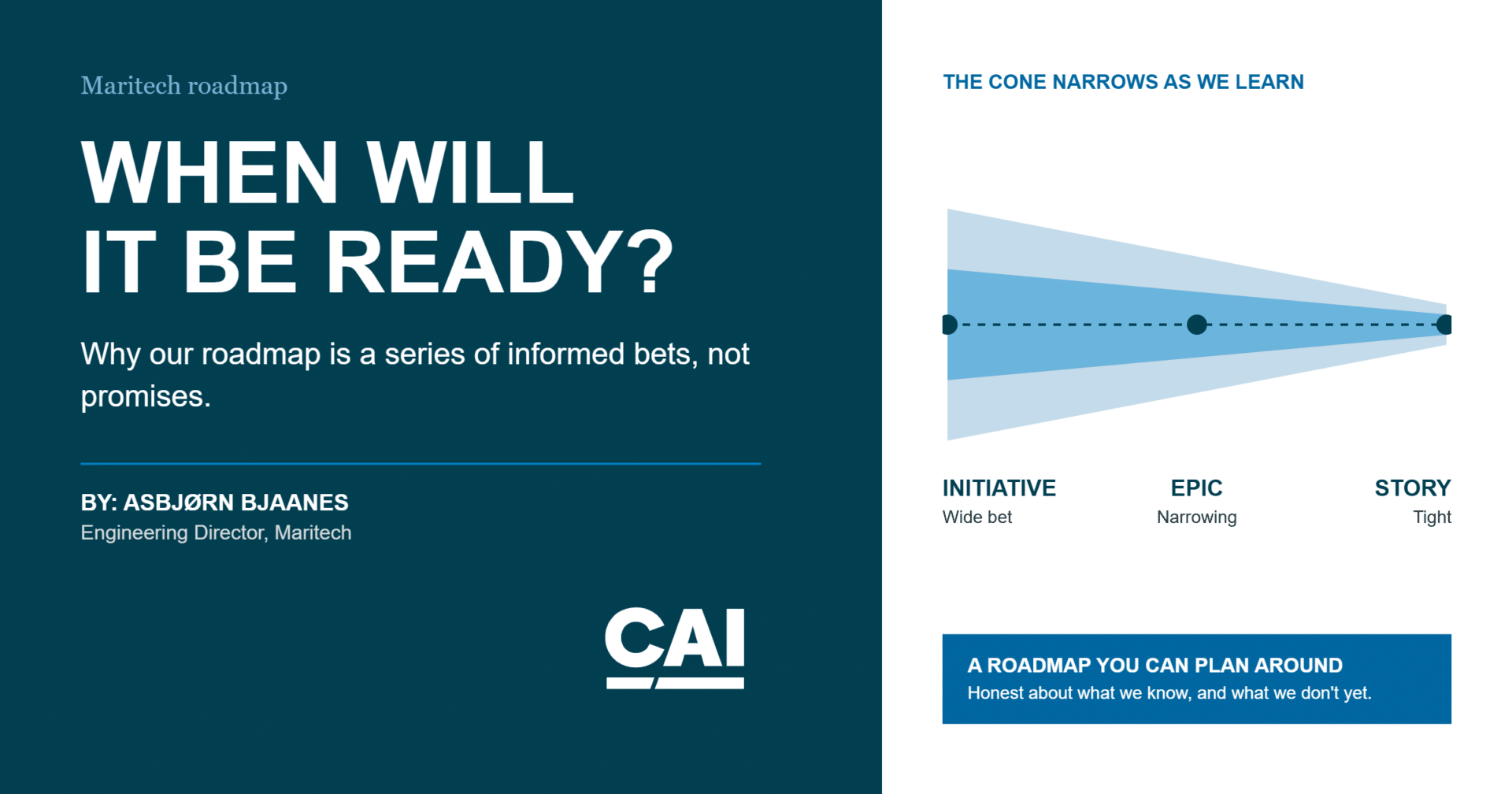
This is not vagueness dressed up as methodology. It is how every credible forecasting system in the world operates. Weather forecasters don’t give you a single point on a map where a hurricane will make landfall. They show you a cone of uncertainty, all possible paths, with the most likely path in the centre. The wider the cone, the greater the uncertainty.
A roadmap should work exactly the same way. Wide at the initiative level. Narrowing at the epic level. Tight at the story level, where the work is imminent and the context is real.
The Science of Probabilistic Refinement
This is what makes a roadmap credible, not the volume of detail, but the honesty of the probability distribution at each layer, and the discipline with which it is updated as evidence arrives.
This is precisely what Bayes’ Theorem describes. You start with a prior belief — your initial bet on the size and timing of an initiative. As evidence accumulates; completed stories, spike results, velocity patterns, you update that belief to form a posterior probability. The posterior is not more accurate because you planned better upfront. It is more accurate because it is informed by real data from inside the work.
This has a critical implication for how teams should think about estimation. Writing 40 stories for an epic before the work begins does not produce evidence. It produces assumptions dressed as detail. The cone does not narrow because you specified more. It narrows because you learned more. And the only way to learn is to start.
Instead of providing single-point estimates, teams can use probabilistic forecasting to communicate ranges of possible outcomes. A team might determine there is a 50% chance they will complete an epic in 8 sprints, a 70% chance in 10 sprints, and a 90% chance in 12 sprints. That is not imprecision. That is an honest model of reality that customers and stakeholders can actually plan around.
The research confirms why the alternative fails. Average time overruns in software development increased from 63% to 82% between 2000 and 2007, a period when detailed upfront planning was standard practice. The planning fallacy arises from optimistic bias and over-reliance on best-case internal scenarios, failing to account for switching costs, typical delays, and unanticipated complexities. Writing more stories does not fix optimism bias. It embeds it deeper into a structure nobody then wants to challenge.
Probabilistic forecasting embraces variation and says: we know there is uncertainty, let us model it rather than pretend it does not exist. That shift, from false certainty to honest probability, is what builds durable trust with customers and stakeholders.
Feeding a prediction model with unearned detail does not reduce uncertainty. It hides it, until reality forces it back into the open.
The Abstraction Ladder
The initiative → epic → story hierarchy exists for a reason. Each layer carries a different confidence level, and that confidence is earned through learning, not declared through planning.
An initiative is a wide bet. Strategic direction, rough size, high uncertainty. It does not need stories yet because the data to justify them does not exist yet.
As the initiative matures into epics, spikes sharpen the probability distribution. A spike is not delivery work — it is learning work. It answers the questions that make the next bet tighter. Each spike is a Bayesian update. The cone narrows.
As epics move toward sprints, stories emerge progressively from work that is actually imminent. An epic estimated at 300 hours might have 150 hours broken into active stories and 150 hours deliberately left as a rough band. As the first stories close, the remaining band adjusts — tighter, more honest, more credible.
That adjustment is the progress signal. The posterior is more accurate than the prior. The cone is visibly narrowing. That is not a planning failure. That is the system working exactly as it should.
Progress Visibility
Three things make progress genuinely visible across the hierarchy.
Initiatives must be tied to measurable outcomes. “Reduce time-to-value for new customers” shows progress. “New onboarding flow” does not.
Epics must carry honest probability ranges, updated as spikes and completed stories narrow the cone. The recalibration is the signal, not a failure to be explained away.
Story-level work belongs in the sprint, not on the roadmap. When customers ask about progress, they are asking at the initiative or epic level. Showing them stories is like answering “how is the journey going?” with a list of left turns.
Show the direction. Show the narrowing cone. Show what you have learned and how it has tightened the picture.
That is a roadmap customers can trust. Not because it promises certainty. Because it is honest about uncertainty, and visibly reducing it, sprint by sprint, bet by bet.
At Maritech, this is how we think about building for seafood & logistics: stay close to the people who use the product, learn early, and tell you what we see as it gets clearer.
Want to know where Maritech is heading, or what it could do for your operation? Take a look at our digital demos here: https://caisoft.com/demos/maritech-seafood/welcome-to-maritech-cloud/introduction/